What the Boat Knows When You're Not There.
"If it's just another box onboard, I'm not interested."
Neil Chapman
It didn't start with insurance.
For Neil Chapman, it started with a conversation — walking through a boat show a few years ago. The usual stands. Equipment, upgrades, add-ons. Most of it familiar in intent, if occasionally new in form.
Then something slightly different.
Not another piece of kit. A different way of thinking about one.
The conversation wasn't about features or specifications. It was about how technology might sit quietly alongside ownership — changing the way a boat is understood when no one is aboard. And, more specifically, how that might affect risk.
Given what Boatshed sees regularly — boats changing hands, gaps in knowledge, assumptions filling in where certainty should be — the line of thinking stood out.
The question was simple......would it actually change anything? Would it affect the economics of ownership?
In practical terms: could it reduce what insurance costs?
In Neil's case, it did. That made the decision to install one on Supertaff straightforward.
A Small Device, Quietly Working
The device— a telematics unit — doesn't present as anything dramatic.
It sits out of the way. Draws minimal power. Connects into the boat without demanding attention.
What it does is equally understated.
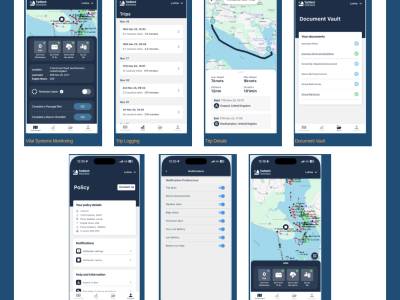
GPS position. Battery health. A bilge alert if water rises where it shouldn't. Weather awareness, depth data, and a basic record of when the boat is actually being used — when trips begin and end.
It doesn't behave like a black box.
There's no analysis of how you sail. No tracking of speed patterns or behaviour. No attempt to score how the boat is handled.
When the boat is idle, it checks in occasionally. When it's moving, it becomes slightly more attentive. Beyond that, it stays largely invisible.
Which is the point.
Learn more about telematics here.
The First Change Isn't Obvious
After installation, nothing dramatic happened.
No sudden insight. No moment where the system flagged something unexpected. The boat remained exactly what it was.
But something shifted.
Not in how the boat was used — that stayed the same. In how it felt to leave it.
There's a difference between assuming everything is fine and having a quiet sense that it probably is. The device doesn't eliminate uncertainty. But it reduces the reliance on chance — on occasional visits, on the hope that nothing has changed since you were last aboard.
Devices like this begin to change that dynamic , by making parts of that unseen time slightly more visible.
A battery dropping earlier than expected. Water where it shouldn't be. Movement that doesn't quite fit the pattern.
Small signals. But signals nonetheless.
There's a layer of awareness now. Not intrusive, not demanding. Just present.
The boat feels slightly less absent when you're not there.
From Assumption to Observation
This is where the insurance question returns.
Traditionally, insuring a boat has involved a degree of estimation. What boat is it? Where is it kept? How is it used? How experienced is the owner? From those answers, risk is constructed — not arbitrarily, but based largely on declared information and fixed points in time.
Surveys capture a moment. Forms capture an intention. Everything in between is, to some extent, inferred.
What telematics begins to change is the nature of that picture.
An insurer can start to see where the boat actually goes. How often it moves. What conditions it's exposed to. Whether key systems appear stable over time.
It's a shift from describing risk to observing it.
In Neil's case, that shift had a tangible outcome — the premium reduced. Not guaranteed, not automatic, and always subject to the insurer's discretion. But enough to show that the model can move when the information improves.
And that begins to alter the equation.
The Question of Being Watched
The idea of tracking raises an immediate concern.
Most owners don't want to feel monitored. The idea of something recording activity — even passively — sits uncomfortably for many.
But the intent here isn't behavioural surveillance. The device isn't analysing how you sail. It's focused on the boat itself — its condition, its environment, its basic patterns of use.
In that sense, it's closer to awareness than oversight.
The aim is not to penalise risk, but to understand it more accurately — and, where appropriate, to recognise boats that are well-maintained and sensibly used. Whether that balance holds will depend on how the technology develops. But in its current form, the direction is not about control
Where This Might Lead
Much of this is still early.
The first year is largely about learning — gathering data, building a baseline, understanding patterns. Not immediately changing pricing, but beginning to inform it.
Beyond that, the potential becomes clearer.
If risk can be understood more accurately, it can be priced more precisely and the dependence on broad assumptions reduces. Better data doesn't remove uncertainty, but it reduces it.
More alignment between how a boat is used and how it's insured. Fewer gaps between expectation and reality. Less guesswork on either side.
A Slight Shift in Perspective
None of this changes what a boat is.
It still needs maintaining. It still ages. It still depends on the judgement of the people using it.
But something small has shifted.
The boat is no longer entirely silent when you're not there.
And overtime, that may matter more than it first appears — because if a boat can quietly show what's happening to it, consistently if not perfectly, the systems built around it may begin to respond in kind.
Insurance, in that context, becomes less about what is declared once a year, and more about what is understood over time.